In our last report, “Why Smart Investors Must Watch for an AI Bubble Now,” Equitas warned about high valuations in Large Cap Growth stocks. U.S. stocks, led by high-tech growth, began to drop in mid-February after a steady start to the year. While we predicted volatility ahead, the market showed us sooner rather than later.
The drop was triggered by new tariffs, which are taxes on goods imported from other countries. In early 2025, President Donald Trump proposed increasing tariffs, especially on cars. This worried investors because higher costs could reduce company profits and slow economic growth. In March alone, the S&P 500, a key measure of U.S. stocks, fell about 6%. Technology companies like Nvidia and Tesla saw larger declines, some exceeding 20% down from their peak.
While further tariff increases will have an impact on American businesses, some argue that the market reaction has been worse than the actual predicted impact on earnings. More than anything else, markets hate uncertainty. In its essence, a stock is a claim on all of the future earnings of a company. A short-term impact can be modeled and discounted. When no one is sure what will happen or how long it will go on, potential outcomes — especially on the downside — must necessarily increase in scope as well.
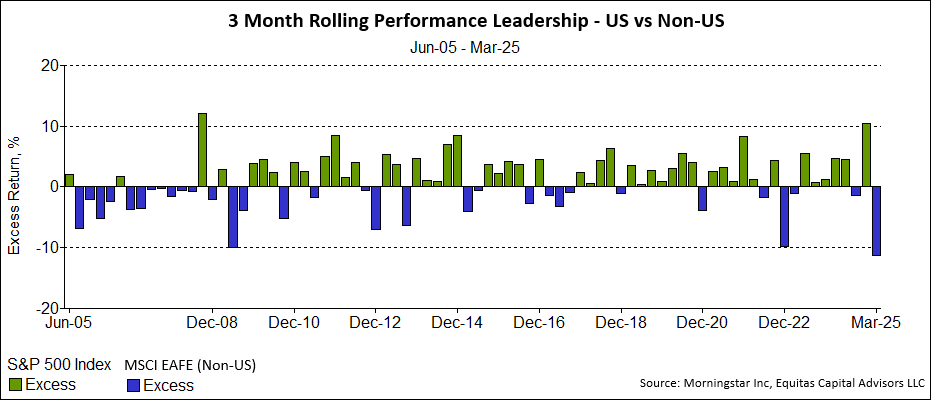
While U.S. stocks struggled, down 4% for the quarter, investments in international and emerging markets produced gains. International markets include countries like those in Europe and Japan, while emerging markets refers to China combined with nations like Brazil and India, which are still developing rapidly. The recent out-performance is just that — recent. It is uncharacteristic in a long period of U.S. out-performance.
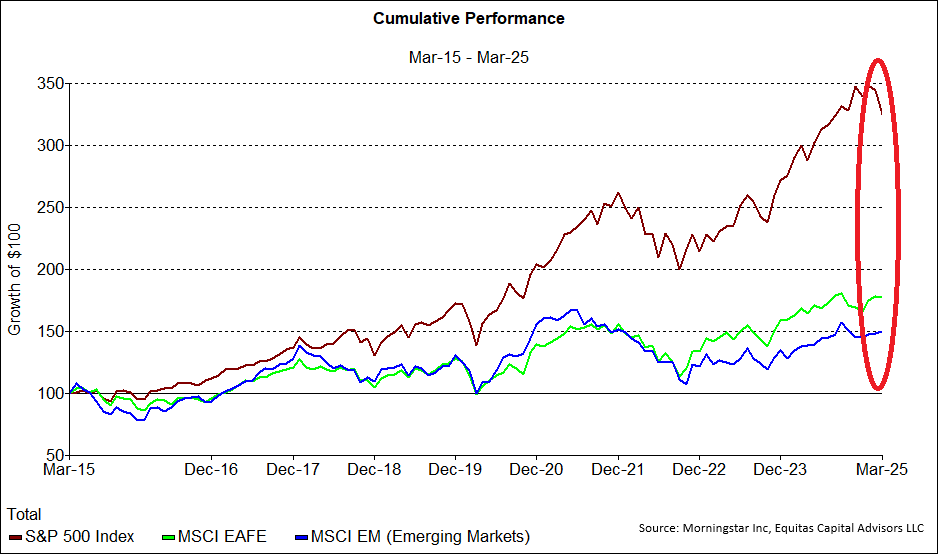
Europe’s stock markets ended the first quarter up 7%, their best start to a year since 1998, partly from increased defense spending which boosted their economies. In China, stocks rose due to growth in technology sectors like artificial intelligence combined with ongoing stimulus measures. While how long this trend lasts remains an open question, the reality is that thus far, the better return from non-U.S. investment is too brief to describe as the start of a new trend.
Turbulent times like now, or especially 2022, can fill the most intelligent of investors with fear. The temptation to run to the safety of cash is tempting, and the fear of further loss can cause paralysis, preventing appropriate return to the market. Consider the stories of Michael and Henry, two investors who faced the same market conditions but made very different choices.
Michael, a successful business owner in his 50s, came to us in mid-2022 when markets were down significantly. Despite anxiety about the markets and his eventual retirement, he trusted our guidance for a diversified portfolio that balanced risk management with growth. The first few months were uncomfortable as volatility continued, but Michael maintained his discipline. By early 2023, his portfolio began to recover, and today, his investment has grown substantially.
Henry’s story took a different turn. When the market declined in 2022, he liquidated his investment portfolio. The immediate relief he felt from stopping the losses soon gave way to a new concern: when to get back in. As markets began to recover in late 2022 and early 2023, Henry remained convinced that another drop was imminent. He waited for the “perfect time” to reinvest, but that moment never seemed to arrive. Each market uptick made him more reluctant to buy in at “higher prices,” while every small correction reinforced his fear that worse declines were ahead. Today, Henry’s family investments remain in cash, earning minimal interest that hasn’t kept pace with inflation, effectively reducing his purchasing power. Worse, he’s watched from the sidelines as the market has delivered substantial returns to his coworkers who stayed invested. Meanwhile, Michael just called our office asking if the tariff sell-off was a good opportunity to rebalance into the market and buy growth while it’s on sale.
These contrasting experiences highlight a fundamental truth about investing: timing the market consistently is nearly impossible, even for professionals. The cost of missing just a few of the market’s best days can dramatically impact long-term returns. Michael’s willingness to embrace discomfort and invest during weakness — with professional guidance — rewarded him with significant growth. Henry’s decision to seek safety, while understandable, ultimately cost him the opportunity to retire earlier.
In 2002, Equitas Capital Advisors, LLC was established as a unique company that blends the resources of a large global corporation with the flexibility of a small boutique firm. The registered service mark of Equitas Capital Advisors is Engineering Financial Solutions® and the purpose of Equitas is to design, build, and deliver investment solutions to meet the goals and objectives of our investors. Equitas Capital Advisors, LLC, located in New Orleans, has over 200 years of combined investment management consulting experience providing professional investment management services to investors such as foundations, endowments, insurance companies, oil companies, universities, corporate retirement plans, and high-net-worth family offices.