The Ultimate Guide to Building Generational Wealth
While our interests are more varied than Mr. Rockefeller’s, dividend investing remains a focus at Equitas. Our 2012 article, “An Interest in Dividends,” sparked the idea that launched our own dividend strategy, tailored for income-focused clients like retirees.
Benefits of Dividend Investing in a Volatile Market
Dividend stock investing is a time-tested strategy that appeals to a broad range of investors, from retirees seeking reliable income to long-term investors focused on compounding wealth. At its core, this approach involves owning shares of companies that return a portion of their profits to shareholders in the form of regular cash payments — known as dividends.
What makes dividend strategies so compelling to clients is the sense of stability and predictability they offer. Unlike growth stocks, which rely heavily on market appreciation and can be volatile, dividend-paying companies are often mature, financially sound businesses with a history of strong earnings. These regular payouts provide investors with tangible income, often on a quarterly basis, that can either be used to meet expenses or reinvested to accelerate growth. This consistent stream of income becomes especially valuable during periods of market turbulence, when price appreciation may be harder to come by.
For example, during the 2008 financial crisis, the Dividend Index declined 35%, compared to losses of 47% for the Value Index and 45% for the Growth Index. Income from dividend-paying stocks held up even better, falling just 23%, and that was the worst year for dividend stocks. The financial origin of the crisis impacted bank earnings, which typically form a large portion of the big dividend payers. A broader study by Moon Capital further supports this point: even accounting for the 23% decline in dividends during the financial crisis, the average dividend cut during bear markets is just 2%.
Furthermore, dividend investing offers several tax advantages that can enhance an investor’s overall returns. In the United States, qualified dividends are taxed at a lower rate than ordinary income, while ordinary (non-qualified) dividends are taxed as ordinary income, at rates up to 37%. Under current U.S. tax law, qualified dividends enjoy more favorable rates:
- 0% for taxpayers in the lowest brackets
- 15% for middle-income earners
- 20% for high-income individuals
- A possible additional 3.8% surtax (NIIT) may apply to high earners
Additionally, dividends received in tax-advantaged accounts like IRAs or 401(k)s can grow tax-free or tax-deferred, allowing investors to compound their returns without immediate tax liabilities. Advisors, working with their clients’ accountants, can help investors offset dividend income with capital losses or deductions.
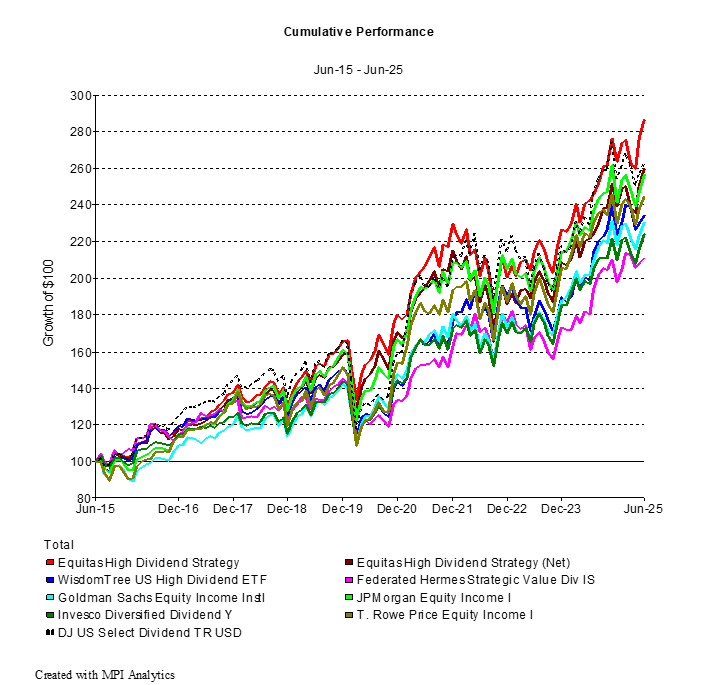
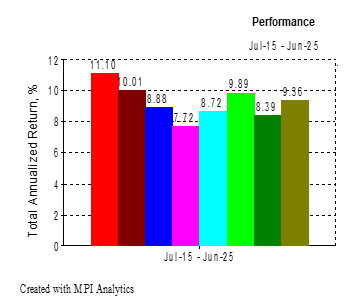
Recently, the Equitas High Dividend Strategy celebrated its 10-year anniversary. Over the past decade, Equitas Capital Advisors has delivered strong results through our deep experience in dividend investing. As of June 30, 2025, our Equitas High Dividend Strategy gained 8.8% (8.3% net) for the first half of the year and 18.1% (16.9% net) over the past 12 months, compared to 3.2% and 14.5% for the dividend index. These returns not only outperformed the style-specific Dow Jones Select Dividend Index but also exceeded the performance of almost all major domestic equity indices during this volatile economic environment. In addition to these strong total returns, the strategy is currently delivering a 4.4% dividend yield with consistent monthly income.
Our 10-Year Record with Dividend Investing
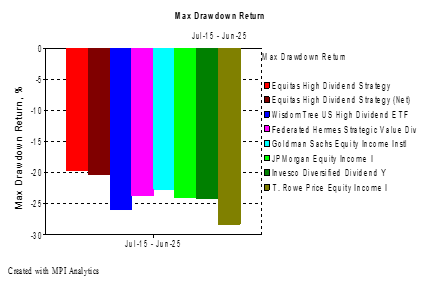
At Equitas, we approach dividend investing with a more balanced strategy — one that not only generates income and provides resilience during down markets, but also retains the ability to participate in up markets. The result is a strong, long-term performance record over the past 10 years: higher yield, smaller drawdowns, and superior returns compared to other dividend funds.
Below are select tables and graphs from our recent dividend manager search. The full report is available for free upon request.

*Net performance includes a max 1% fee.
Equitas Capital’s proprietary Dividend Equity Strategy employs a hybrid approach. We blend both high-dividend-yield stocks for immediate income (examples include AT&T, Welltower, and Altria) and dividend-growth stocks for long-term appreciation (examples include Microsoft, IBM, and JPMorgan Chase) to create a balanced portfolio that delivers both current income and future growth potential. The strategy utilizes a research-driven selection process with over 20 sector-specific metrics across five key dimensions — valuation, financial health, profitability, dividend consistency, and technical trends — to identify quality companies with sustainable dividends while avoiding yield traps. With thoughtful diversification across 40+ stocks spanning all 11 major S&P sectors, the portfolio is designed to provide durable income, steady capital appreciation, and enhanced risk-adjusted returns without over-concentration in any single industry. Please contact us for more information on our High Dividend Strategy and the companies we invest in.
In 2002, Equitas Capital Advisors, LLC was established as a unique company that blends the resources of a large global corporation with the flexibility of a small boutique firm. The registered service mark of Equitas Capital Advisors is Engineering Financial Solutions® and the purpose of Equitas is to design, build, and deliver investment solutions to meet the goals and objectives of our investors. Equitas Capital Advisors, LLC, located in New Orleans, has over 200 years of combined investment management consulting experience providing professional investment management services to investors such as foundations, endowments, insurance companies, oil companies, universities, corporate retirement plans, and high-net-worth family offices.