In September 2024, Jerome Powell announced the first Federal Funds Rate cut in over four years. The Federal Funds Rate is a short-term rate related to the cost of debt in the American economy. Some expected the Federal Reserve to cut only 25 basis points, but they delivered a 50 basis point cut. Powell explained this as a result of data that had grown unexpectedly worse since the Fed’s last meeting. We think they are also being a bit more proactive than they have in the past, which is a good sign.
August’s inflation reading (released September 27th) confirmed the softening trend, seeming to emphasize the appropriateness of the Federal Reserve’s double cut, and possibly signaling more ahead for this year as the Fed becomes less concerned with inflation. With the neutral rate nearing 2%, they have plenty of room.
In recent history, both the 2000 Dot Com crash and the 2007 Financial Crisis rate cutting cycles started with a 50bps cut. These cuts, delivered after major negative impacts, foretold ominous future developments. We’ve also had one of the longest periods with an inverted yield curve, which is another negative indicator when short-term interest rates are higher than rates for bonds with maturities further in the future. Similarly, the “Sahm Rule,” named after a former Fed economist, just turned negative. This indicator predicts recession whenever unemployment increases half a percent within a year. Despite that, even Claudia Sahm herself states that her rule is “too simple for the complicated economic situation the U.S. is in right now.” Still, she urges vigilance.
The metrics we track on our Economy Monitor page show consumer debt, unemployment, and other measures normalizing from historic lows after all the government stimulus spending in the wake of COVID. These signs seem to confirm Sahm’s augury that the economy remains healthy.
Given that rates are coming down and it’s reasonable to expect growth to remain adequate, what does that mean for your investments? To study this, Equitas had to look further back for rate cuts that happened without negative economic shocks. From 1990–2000, there was a single recession, related to the 1990 oil price shock. However, there were three other instances of falling Fed Funds Rates. We can closely examine these periods in order to identify potential trends, or a lack of a trend.
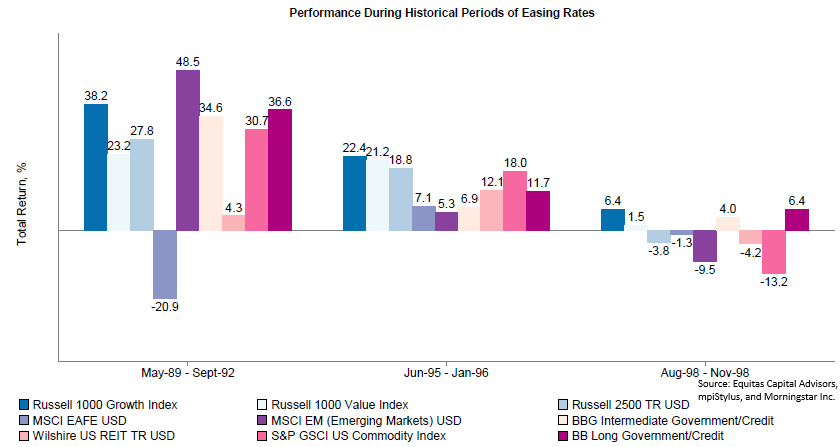
In these particular periods, Large Cap Growth (represented by the Russell 1000 Growth) performed particularly well. Interestingly, so did the Long Government/Credit Bond index. Both of these investments are considered to pay off more into the future than today, with lower rates increasing the value of those future payoffs. Alternatively, Emerging Market Equities — represented by the MSCI EM index — had the greatest variability, doing best in the 1989–92 cycle but falling to second-to-last in the ’98 easing cycle. International markets seem similarly uninspiring.
In review, this is a time to remain vigilant. As history shows, sometimes the only difference between a healthy economy and the brink of recession is avoiding an unexpected shock that impacts the global economy. With open hostilities overseas and labor disputes at home, a prudent investor can find plenty to worry about. While allocations based on 20-year long assumptions can get rocked in the short term, more frequent positioning has the potential to keep your portfolio closer to where the market is moving.
As always, Equitas is continuing to monitor leading economic indicators, technical indicators, and global developments on behalf of our clients. Please don’t hesitate to reach out if you have any questions or would like to discuss how these developments impact your specific financial situation.
In 2002, Equitas Capital Advisors, LLC was established as a unique company that blends the resources of a large global corporation with the flexibility of a small boutique firm. The registered service mark of Equitas Capital Advisors is Engineering Financial Solutions® and the purpose of Equitas is to design, build, and deliver investment solutions to meet the goals and objectives of our investors. Equitas Capital Advisors, LLC, located in New Orleans, has over 200 years of combined investment management consulting experience providing professional investment management services to investors such as foundations, endowments, insurance companies, oil companies, universities, corporate retirement plans, and high-net-worth family offices.