Five percent and higher used to be considered normal for interest rates. Then, for almost 20 years, it was hard to find. On September 30, the 10-year Treasury closed at 5.29%, the highest it has been since 2002. If you started borrowing or saving after 2002, you have never seen government debt cost this much.
Two weeks before that, the Federal Reserve raised its own short-term rate by a quarter of a percent. It went to a range of 3.75% to 4.00%. Every member of the committee voted yes, with most indicating that further hikes are necessary. That hike was the first rate increase since July 2023.
While short term rates barely moved, the 10-year rate increased +1.11% over the past year. People who borrow money felt the change months before the Fed voted. The bond market did the Fed’s job.
The Fed sets the very short-term rate that banks charge each other. Most other short-term rates follow it. The market sets the 10-year rate through expectations surrounding future short term rates, growth, inflation, and deficit spending. Mortgages and most long-term loans are based more directly on the 10-year, not the Fed’s press conference.
Interest Rate Curve
| Sep 30, 2026 | Start of 2026 | This year | |
|---|---|---|---|
| 3-month bill | 4.20% | 3.67% | +0.53 |
| 2 years | 4.88% | 3.47% | +1.41 |
| 10 years | 5.29% | 4.18% | +1.11 |
| 30 years | 5.64% | 4.84% | +0.80 |
| 10 years, after inflation | 2.93% | 1.93% | +1.00 |
| Fed rate (top of range) | 4.00% | 3.75% | +0.25 |
Treasury rates by maturity. Changes are in percentage points. The row labeled ‘after inflation’ shows what lenders earn once inflation is taken out. Sources: US Treasury; Federal Reserve.
Every rate is higher than it was a year ago. The 2-year rate moved the most, up +1.41% this year. That rate helps set the price of car loans, business loans, and corporate debt. Also, the rate after inflation rose about as much as the regular rate. Investors are not suddenly more worried about just inflation. Additional factors such as the increased debt issuance, higher growth, and investors increasing preference for equities over bonds also contributed to the recent move.
The Fed also put out its own forecast:
What the Fed Expects
| 2026 | 2027 | 2028 | Long run | |
|---|---|---|---|---|
| Fed rate at year-end | 4.1% | 4.1% | 3.9% | 3.2% |
| Expectations as of June 30, 2026 | 3.8% | 3.6% | 3.4% | 3.1% |
| Inflation | 3.7% | 2.3% | 2.1% | 2.0% |
| Economic growth | 2.3% | 2.4% | 2.2% | 2.0% |
| Unemployment | 4.1% | 4.1% | 4.1% | 4.2% |
Federal Reserve forecast from September 16, 2026. The June numbers are what the Fed expected three months earlier.
The Federal Reserve Committee itself only foresees one more rate increase. Then, the rate stays near 4% through 2027. Cuts do not start until 2028. Even in the long run the Fed sees the rate at an elevated 3.2%. Since June, the Fed has raised its forecasts for both growth and inflation, while lowering its forecast for unemployment. This is a central bank raising rates while the economy is strong, not while it is slowing down.
Long-time clients will remember a 1% Treasury rate. Back when we wrote the “Return-Free Risk” in 2012 and “The Warning Label” 2014, we did not know that long government bonds would later lose over half their value. We just thought 1% was not enough pay for the risk. The market proved the thesis with the aggregate bond index down half a percent over the past five years. Now the math has flipped. Five percent is growing attractive compared to dividend yields. The move in yields also reminds us that the price of a long bond can still fall if rates go higher.
The Fed chairman gave three reasons rates rose: a strong economy, big technology companies borrowing a lot of money to build, and conflicts overseas pushing up energy prices. Some people say a 3% after-inflation rate is healthy because growth justifies it. Others argue that high rates are a tax on long cycle investment. Long cycle investments include houses, growth stocks, and long-term contracts. The open question is whether the growth that contributes to the high rate can hold up with the high rate.
Consumer prices rose 3.4% in the year to August. Energy costs rose 16.3%, food increased 2.7% and housing was up 3.0%. Without food and energy, core prices rose 2.4%. Right now, inflation is mostly an energy story. The next inflation report is forecast to land around 3.6% to 3.7%.
The job market just started to slow. September added only 29,000 jobs with unemployment at 4.2%. July was revised to a loss. While one weak month is not a trend, it is enough to make a rate increase in October unlikely. Markets now put the odds of no change on October 28 at about 80%.
Housing feels long-term rates right away. The average 30-year mortgage rose to 7.28% on October 1. A year earlier it was 6.34%. On a $350,000 loan, that difference is $219 more every month. A three-month Treasury bill pays 4.20%. A mortgage now costs about 3.1 points more than cash earns. A year ago the gap was 2.3 points. This has created a dislocation in the market with 58% more sellers than buyers. Similarly, mortgage companies value has dried up along with their revenues. UWM, America’s largest mortgage lender has lost roughly 90% of its value from peak in the past two years.
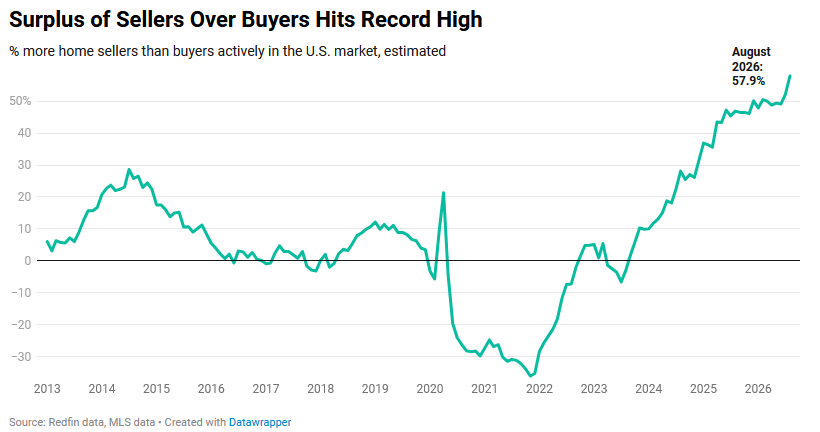
Long-term borrowing costs for home buyers, companies, and cities rose this year even though the Fed did very little. Here are four things worth paying attention to.
- Long bonds pay more, but they can still lose money. At 5.29% the 10-year pays more than it has since 2002. If rates rise another point, its price falls about 7%. A 30-year bond falls about 13%.
- Cash is worth something again. A Treasury bill pays 4%. That is about 0.6 points above the latest inflation rate before tax. After tax it is close to breaking even. If you have cash sitting around by habit, it should be earning near 4%.
- Households are paying for all of it at once. Mortgages, energy, and food are all rising together. The customer who only buys once in a while steps back first. With soft payrolls, consumer stress will show up in delinquency rates for auto loans and mortgages, then credit spreads more broadly.
- Don’t fight the Fed. The Open Market Committee penciled in further rate hikes, but every meeting is a live event that could change future expectations. If the economy becomes a larger concern than inflation, rates may reverse course.
What would change this view? Rates could go higher if September inflation comes in at 3.7% or above, if energy prices jump again, or if total debt issuance rates keep climbing. Rates could come down sooner if a second weak jobs report lands, or if a big borrower gets into fiscal trouble. Cooler inflation prints could steady the Fed’s hand.
Five percent is not a crisis. High rates are the price of money when the economy is still growing, businesses are still borrowing to build, and inflation is still above target. The bond market set that price before the Fed had to. With rates at this level, is it worth adding safety to your portfolio?
In 2002, Equitas Capital Advisors, LLC was established as a unique company that blends the resources of a large global corporation with the flexibility of a small boutique firm. The registered service mark of Equitas Capital Advisors is Engineering Financial Solutions® and the purpose of Equitas is to design, build, and deliver investment solutions to meet the goals and objectives of our investors. Equitas Capital Advisors, LLC, located in New Orleans, has over 200 years of combined investment management consulting experience providing professional investment management services to investors such as foundations, endowments, insurance companies, oil companies, universities, corporate retirement plans, and high-net-worth family offices.